

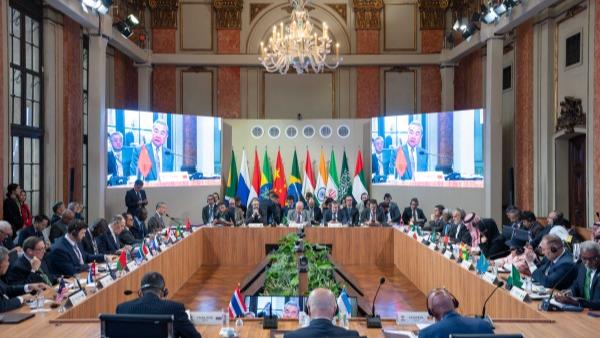
BRICS: A Growing Global Influence
In a rapidly changing world, the influence of BRICS is undeniable. Initially, it comprised Brazil, Russia, India, China, and South Africa. However, recent developments have seen Indonesia join, and the group’s appeal grows even stronger.
BRICS’s Expanding Membership
On January 6, 2025, Brazil, holding the rotating chair, announced Indonesia’s official entry. This move increases the bloc to 11 nations, accounting for almost half of the global population and over 30% of world GDP. Indeed, BRICS’s contribution to global economic growth exceeds 50%, a testament to its rising stature in international affairs.
A Historic Addition
Before Indonesia, the bloc saw a significant enlargement in January 2024. Saudi Arabia, Egypt, the UAE, Iran, and Ethiopia joined, marking a new era of “Big BRICS cooperation.” The inclusion effectively doubled the membership and substantially increased BRICS’s global clout.
Origins and Evolution
The term “BRIC” was coined by Jim O’Neill in 2001, highlighting Brazil, Russia, India, and China’s potential. By 2006, these nations formalized the group in New York. South Africa’s inclusion in 2010 transformed the acronym to BRICS, marking an essential step in its growth.
Economic Strengths and Cooperation
Table: BRICS Trade Growth with China (2024)
| Trade Aspect | Growth Percentage |
|---|---|
| Exports of Steel (to BRICS) | 8.6% |
| Textile Raw Materials | 13.4% |
| Intermediate Goods Growth | Double-digit |
The combined strengths of BRICS create an economic powerhouse. With substantial labour forces and vast consumer demand, these markets attract significant foreign capital. Saudi Arabia’s role as a major oil exporter enhances BRICS’s energy influence. Meanwhile, Egypt’s control over the Suez Canal solidifies the bloc’s position in global logistics.
Growing Trade Relationships
In 2024, China’s trade with BRICS nations reached 4.62 trillion yuan (approximately $648 billion), growing by 5.1% year-on-year. Such growth is not merely quantitative. It reflects expanding and diversified exchanges, as highlighted by the rise in Chinese poultry and frozen pollack imports from BRICS countries.
Fostering Technology and Innovation
BRICS is more than just trade. As Hong Yong from the Chinese Academy of International Trade and Economic Cooperation notes, it fosters technological exchange and drives innovation. This cooperation creates opportunities not just for members but the world.
Towards an Equitable Global Order
BRICS’s allure isn’t solely economic. Al Jazeera reports that many Global South nations view it as a platform for fairer international relations. Likewise, TRT observes its focus on economic cooperation over political alignment boosts its appeal.
Professor Wang emphasizes BRICS’s aim to voice emerging economies, promoting modernization through sovereign development. Its core values of openness and inclusiveness resonate worldwide. As Wei Qijia states, BRICS embodies a win-win vision of globalization, empowering the Global South.
A Symbol of Unity and Cooperation
Indeed, the expansion reflects a shift in global dynamics. As more countries show interest, BRICS epitomizes the trend toward inclusive multilateralism. An ancient Chinese poem perfectly captures this spirit: “Boundless is the ocean where we sail with the wind.” For many, BRICS is quickly becoming that guiding wind.
