

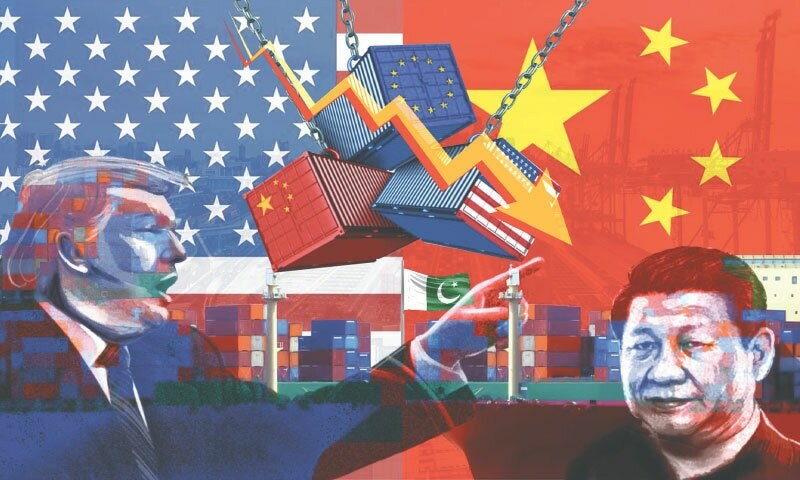
## A Superpower in Disarray
Donald Trump, the former US President, is grappling with an international arena far larger than he initially understood. His instruments of influence, once perceived as formidable, are proving inadequate in subduing an interconnected world. The erratic nature of his decisions, driven by a fickle temperament and insensitivity towards allies and opponents, has left an indelible mark on America’s global standing. Trump’s actions have portrayed America as an unreliable trade and security partner.
### Trump’s Tariff Turmoil
While contemplating Trump’s global tariff gambit, one must ponder the end goals behind such drastic American measures. Khurram Husain delves into the motives behind this upheaval, examining its repercussions on entities like Pakistan. Larger forces at play indicate a significant shift in the long-established post-war global order. This burgeoning change especially affects fragile economies like Pakistan’s.
### The Immediate Effect on Pakistan
Initially, it’s essential to quantify the impacts of these tariffs financially. Pakistani exports currently face a 10% increase in tariffs in the US, a burden also shared by Pakistan’s competitors. China, however, is hit with a crippling 145% tariff. Alarmingly, a policy note by the [Pakistan Institute of Development Economics](http://www.pide.org) predicts a potential $1.4 billion drop in Pakistan’s total exports due to these tariffs.
| Country | Tariff Increase | Expected Impact on Exports |
| ————— | —————— | ————————– |
| Pakistan | 10% | $1.4 billion less |
| China | 145% | Severe reduction |
Though Pakistan is yet to experience such severe tariffs, these projections underline the economic strain they could bring.
### A Fragile Economy in a Changing World
The rapid metamorphosis of the global landscape poses near existential challenges for Pakistan. Since 1988, Pakistan has leaned heavily on [International Monetary Fund](https://www.imf.org) (IMF) bailouts. A disquieting frequency of IMF interventions paints a picture of an economy perpetually on the brink. Each intervention came at critical moments when foreign exchange reserves were nearly depleted, jeopardizing energy and trade continuity.
### Pakistan’s Financial Trials and Tribulations
From energy crises in 1999 to near financial meltdowns in 2008, Pakistan has weathered many storms. The world’s support has been pivotal in stabilising the country over the decades. Yet, today’s stability hangs by a thread, overshadowed by austerity measures tied to ongoing IMF programmes. Moving forward, the real danger looms if no foreign aid comes when Pakistan faces another currency crisis. If bankruptcy-like conditions persist, societal chaos is inevitable.
### Global Geopolitical Chaos
With Trump’s actions, unpredictability reigns supreme. His economic strategies, including purported “Liberation Day” tariffs, produce financial chaos. On the day these were to take effect, global financial systems shuddered. Stock markets plummeted while bond yields soared, catching everyone off guard.
#### Untenable Financial Conditions
The 10-year Treasury bond yield spiked as stock prices collapsed, hearkening back to the instability last seen during the 2013 fiscal uncertainty. It’s clear that financial markets are ensnared in Trump-induced unpredictability. Their inability to handle such volatility underscores the gravity of the present disorder.
### Decoding Trump’s Intentions
Theories explaining Trump’s unpredictable tariffs abound. Firstly, many believe the tariffs attempt to rebalance trade disparities with China by emulating historic trade measures. Alternatively, some suggest this is a geopolitical manoeuvre. Finally, some embrace the “Madman Theory,” positing Trump as an unpredictable, egotistical figure more concerned with self-image than trade balance.
#### The ‘Mar-a-Lago Accord’ Myth
Akin to the failed historical Plaza Accords of 1985, Trump’s supposed strategy involved coercing countries to pick sides between the US and China. By leveraging security provisions, the US aimed to isolate China economically. However, the world demonstrated resilience, prompting China and the European Union to retaliate with their own tariffs.
### Global Power Dynamics
Some, like Doug Irwin, argue these tariffs are fundamentally geopolitical. In his [Financial Times interview](https://www.ft.com), Irwin notes that geopolitical dynamics have historically shaped global trade patterns. With China’s ascent challenging the US’s dominance, frictions were bound to arise. Ultimately, such tensions were destined to surface with any leader, although Trump accelerated their progression.
### A Descent into Madness
The most straightforward theory opines that Trump’s policies lack rational basis, driven instead by ego and possible corruption. Essayists like [Anusar Farooqui](https://anusar.substack.com) and reputable journalists such as [Janan Ganesh](https://www.ft.com) note Trump’s actions as irrational and potentially self-serving. [Anne Applebaum](https://www.theatlantic.com), writing for [The Atlantic](https://www.theatlantic.com), shakes the kleptocracy alarm, echoing thoughts of Trump potentially using policies for personal financial gain.
### What Lies Ahead
Every explanation harbours some truth as America, a beleaguered superpower, faces mounting challenges. The intertwined global economy means that addressing China’s growth requires calculated, multifaceted strategies. Nevertheless, Trump’s erratic approach creates vulnerabilities, making the US’s global leadership position vulnerable. From a larger perspective, necessary actions have been usurped by heedless motivations.
The world is watching, and so too are those at the helm of fragile economies like Pakistan.
*The writer, a business and economy journalist, tweets at [@khurramhusain](http://twitter.com/khurramhusain) and can be reached at [email protected]. Published in Dawn, EOS, April 20th, 2025.*
