

markdown
Contents
China’s Chip Market: A Jolly Good Surge
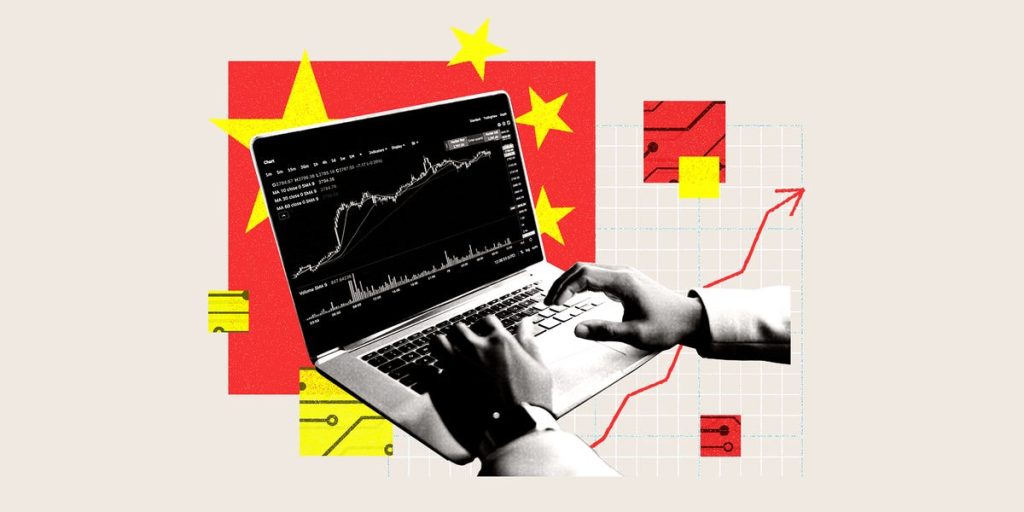
A tale of chips and AI, dear readers! The recent US ban on advanced AI chip exports has set China’s chip stocks ablaze. Investors are rushing to back local companies, resulting in quite the stock market frenzy. This surge in enthusiasm has even prompted some firms to caution that their share prices might have drifted far from reality.
The Catalyst: DeepSeek and US Restrictions
It all began with the emergence of a cost-efficient AI model, DeepSeek, earlier this year. This spurred a rally that gained momentum with Washington’s chip export restrictions, leaving domestic players ample room to expand. “It’s a bigger market opportunity with Nvidia’s absence,” Ray Wang of Futurum Group commented.
China’s tech sector has witnessed a renaissance. Despite enduring a property crisis and trade tensions with the US, the Hang Seng Tech Index has soared 67% in 2025. This turnaround follows years of stagnation after Beijing’s tech crackdown.
The Rise of Cambricon: An Exciting Leap
In the thick of China’s tech rally, notable success has been enjoyed by Cambricon, a Beijing-based AI chipmaker. Its revenue skyrocketed by 4,300% to 2.88 billion Chinese yuan in the first half of 2025. The company’s stock on the Shanghai Exchange has nearly doubled, reflecting not just current performance but future potential, as noted by Wang.
Other Chinese chip stocks are also experiencing significant gains. SMIC and Hua Hong Semiconductor have increased by 83% and 118%, respectively. However, the fervour might be overblown, according to BofA’s Winnie Wu.
The Gentry of Big Tech
The excitement isn’t limited to chips alone. Tech giants such as Alibaba and Tencent have seen their stocks rise by 66% and 48% this year. They are investing heavily in generative AI and cloud computing.
Competition in China is as fierce as ever. Companies like Alibaba, ByteDance, Tencent, Huawei, and Cambricon are leading the charge, yet not quite at Nvidia’s level. Still, the demand for Nvidia’s offerings remains substantial due to their technological edge.
Navigating US Export Controls
The US first imposed AI chip export restrictions in 2022, intensified under President Trump. This move aimed to curb China’s access to cutting-edge tech. Even Nvidia’s H20 model faced curbs. Last month, however, the US relented slightly, allowing Nvidia and AMD to sell certain chips to China, albeit with 15% of revenue shared with the US government.
Further developments could impact global chip supply. The US plans to retract TSMC’s privileges for exporting to its Nanjing fab, possibly limiting China’s chipmaking capacity.
The Mania Unfolds: Balancing Enthusiasm with Prudence
In light of this robust growth, some volatility has emerged. Cambricon’s shares dipped 17% after a strong upward run. The key question is, where next?
“I’m hesitant to predict another 20% or 30% growth, given this year’s huge gains,” Wang advised. Instead, he recommended exploring niche supply chain opportunities, such as optics and hardware components.
As we look ahead, will China continue its ascent in the chip and AI arenas? Only time will tell, but one must say, it’s truly an exciting time for market watchers.
