

markdown
Contents
Global Economic Prospects: An Englishman’s Perspective
The global economic outlook, as per the OECD’s latest report, is rather bleak. There’s an evident slowing in growth, primarily affected by substantial trade barriers and financial tightening. Let us explore the key insights and potential repercussions of these findings.
A Gradual Slowing of Growth
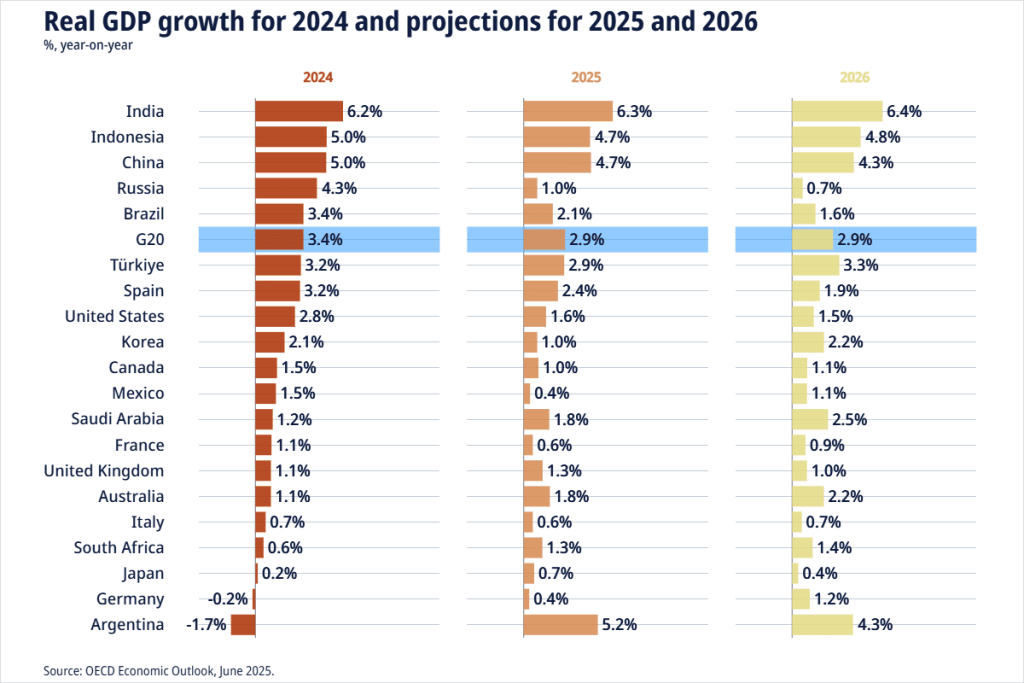
Growth projections by the OECD depict a worrisome trend. Global growth, after achieving 3.3% in 2024, is expected to falter, sliding to 2.9% in 2025, and maintaining this slower pace into 2026.
The United States, Canada, Mexico, and China show the most significant slowdowns. The United States, for instance, might see its GDP growth plunge from 2.8% in 2024 to a mere 1.5% by 2026. The euro area, however, shows a modest uptick from 0.8% to 1.2% over the same period.
The Case of China and Beyond
China, once the torchbearer of rapid economic expansion, is anticipated to see its growth soften from 5% to 4.3% in 2026. On a brighter note, Australia displays resilience. Its GDP growth is set to improve from 1.1% to 2.2% by 2026.
Further insights and data can be explored in the OECD’s detailed Economic Outlook.
Tariffs and Inflation
Economies are grappling with resurfaced inflationary pressures. Tariff hikes are expected to stoke these pressures, albeit mitigated by somewhat diminished commodity prices. For the G20 nations, inflation is poised to moderate from 6.2% to 3.2% by 2026.
Risks and Uncertainty
OECD’s secretary-general Mathias Cormann emphasizes the shift towards an uncertain economic path. Trade fragmentation risks, such as new tariffs, could exacerbate economic deceleration and disturb global supply chains.
Persistent inflation could push economies towards more stringent monetary policies. Such measures might weaken growth prospects further, especially where labour markets are tight and trade costs are high.
Fiscal Challenges and Opportunities
Governments face increased debt payments and fiscal pressures. Emerging economies, in particular, could find themselves squeezed under harsher financial conditions. Conversely, the removal of trade barriers might enhance growth prospects and reduce inflation.
In this turbulent landscape, central banks must remain alert. Stability depends on keeping inflation expectations anchored and avoiding intensified trade tensions. Economies with subdued demand growth could indeed see policy rate reductions if these conditions hold.
Structural Reforms: A Silver Lining?
Economic uncertainties highlight the dire need for structural reforms. An ambitious agenda focusing on business investment, innovation, and productivity is paramount. As OECD chief economist Álvaro Santos Pereira notes, investment has dwindled since the financial crisis, impairing growth.
Greater investment, especially in digital and knowledge-based sectors, is indeed a welcome trend. However, stagnation in public investment and housing requires urgent attention. A robust reform agenda could strengthen the global economy, paving a hopeful path for the future.
The OECD remains a vital source for ongoing analysis and recommendations in these challenging times.
